
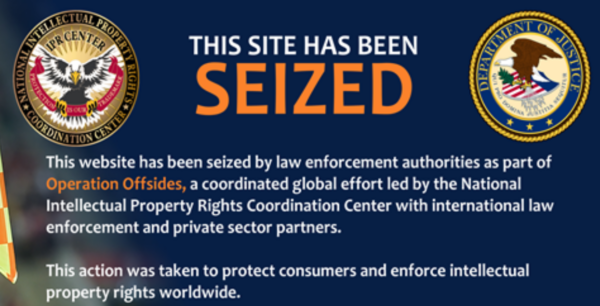
 Operation Offsides was the largest sports piracy crackdown ever carried out during a single event.
From the start of the FIFA World Cup through the final, U.S. authorities and their partners seized more than 1,000 domains, while close to 2,000 more were blocked across Latin America.
The Motion Picture Association, which coordinated the effort through its Alliance for Creativity and Entertainment (ACE), previously praised the operation as a massive success. However, in an op-ed published by RealClearMarkets yesterday, MPA’s leadership admits that domain seizures have their limitations.
“It Does Not Dismantle the Business”
The op-ed, titled “Blowing the Whistle on World Cup Piracy,” is written by MPA Chairman and CEO Charles Rivkin and IPR Center Director Ivan Arvelo. It celebrates the operation as a clear success, noting that the seized sites racked up more than 156 million visits in July alone before they were taken offline.
Indeed, disrupting millions of potential visits has an impact. However, the crackdown also had its limitations, as it does not take out the operations running these sites. These limitations are also recognized in the op-ed.
“A takedown is essential, and it can interrupt access for a moment. But it does not dismantle the business behind it,” Rivkin and Arvelo write.
This is not the type of admission you expect from the MPA or the IPR Center, who just completed the largest piracy domain seizure round in U.S. history. However, the framing does nicely set up the policy argument that follows. At the same time, it corroborates our earlier coverage.
The Russian and Iranian Domains That Survived
Two weeks before the op-ed appeared, we reported that several major pirate streaming brands had switched to fallback domains on Iran’s .ir country-code TLD, in an apparent effort to move to infrastructure that is harder for U.S. law enforcement to reach.
Iranian domains have significant drawbacks of their own, especially for those operations who want to run ads, so there is no mass exodus. However, many that migrated to the .ir TLD remain online today.
A check this week shows that Buffstreams, Footybite, Totalsportek, and Nflbite brands all remain reachable on their .ir fallbacks. None have been suspended or seized, which is no surprise since Iranian authorities are not eager to cooperate with the U.S.
Meanwhile, the largest sites were never dependent on U.S.-controlled infrastructure to begin with. A popular Futbol-libres domain, for example, operating on the Russian-run .su registry, was not among the seized domains and reportedly drew more than 200 million visits in July, according to Similarweb data. That is more than the 156 million visits the MPA counted across all seized domains.
MPA Sees More Attack Vectors
While domains are just part of a site’s infrastructure, it is clear that domain seizures have their limitations. This is not news to the MPA and ACE, who are constantly tracking these domain name migrations.
Speaking with TorrentFreak, MPA’s Executive Vice President and Chief Content Protection Officer Larissa Knapp notes that these familiar tactics are not without weaknesses.
“Piracy operators regularly move domains and infrastructure in an effort to evade enforcement. The migration to .ir domains is another example of that tactic, but changing a domain does not put an illegal operation beyond reach,” Knapp says.
“These services still depend on identifiable operators, hosting, distribution, payment systems, and other technical and commercial infrastructure. That is why ACE works closely with law enforcement and industry partners around the world to identify and disrupt the people and infrastructure that keep these criminal networks operating.”
Knapp suggests that pirate sites rely on a broader infrastructure than domain names alone, so MPA and ACE try to find other weak spots to bring them down. And that’s not all.
Pirate Site Blocking as Solution
This brings us back to the op-ed, which ends with a clear policy ask. Rivkin and Arvelo argue that domain seizures alone cannot solve live sports piracy, and that the U.S. needs “every tool” available to fortify its anti-piracy work.
“Chief among them would be judicial site blocking in the U.S.,” they write, describing it as an anti-piracy tool that’s already used in nearly 60 countries.
The MPA and IPR Center heads see domain seizures as part of a broader enforcement toolbox, which should be complemented with site blocking. While Iranian and ‘Soviet Union’ domains are not mentioned, these could be key site blocking targets.
The site blocking call comes at a time when U.S. site blocking legislation is high on the political agenda again. On June 30, the House IP subcommittee held a hearing on online copyright enforcement, where Chairman Rep. Darrell Issa signaled that bipartisan, bicameral agreement was near.
Thus far, such a unified U.S. site blocking bill has yet to be introduced, but it seems to be only a matter of time. That also applies to the overblocking concerns, which will undoubtedly come, as will the eventual evasive tactics of pirates.
From: TF, for the latest news on copyright battles, piracy and more.
Powered by WPeMatico


