
 In a complaint filed at a Nashville federal court in 2023, Universal Music, Sony Music, EMI and others, accused X Corp of ‘breeding’ mass copyright infringement.
The social media company allegedly failed to respond adequately to takedown notices and lacked a proper repeat infringer policy. The National Music Publishers Association (NMPA) claimed it had sent over 300,000 formal infringement notices, many of which didn’t lead to immediate removals.
The battle escalated in January, when X Corp. filed a landmark antitrust complaint against the NMPA and a coalition of major music publishers, accusing them of coordinating a “weaponized” DMCA takedown campaign to coerce X into industry-wide licensing deals.
These explosive allegations set the stage for a high-profile legal battle. However, it didn’t get that far.
Last week, both lawsuits ended without any further fanfare. Joint stipulations of dismissal were filed in the Middle District of Tennessee and the Northern District of Texas on the same day, with identical terms. In both cases, all claims dismissed with prejudice, with both sides paying their own fees and expenses.
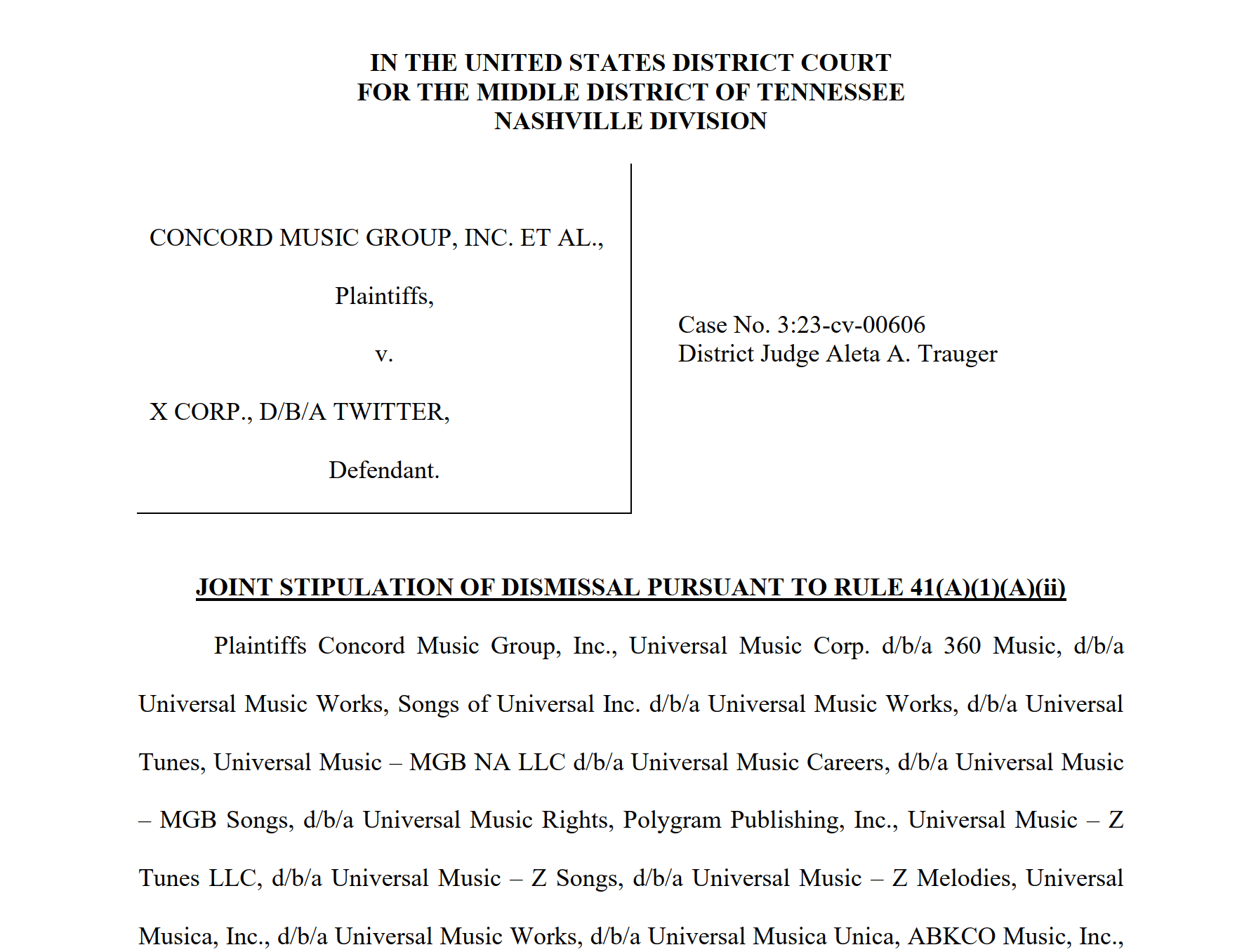
The coordinated timing and matching language leave little doubt that these cases were resolved as part of a package deal.
From ‘Maximum Pain’ to Package Deal
The settlement ends a legal battle that took several dramatic turns.
In 2024, X scored a partial win when the court dismissed the music publishers’ direct and vicarious copyright infringement claims, and partially dismissed claims of contributory infringement.
Judge Trauger concluded that X can’t be held liable for making it ‘very easy’ to upload infringing material or for monetizing pirated content. These characteristics are not exclusive to infringing material and apply to legitimate content too, she argued.
The reduced lawsuit continued and by June 2025, X filed a heavily redacted motion to compel, alleging that the NMPA had used its takedown notice campaign to inflict “maximum pain” on X’s business, to motivate Elon Musk’s platform to sign music licensing agreements.
This revelation appeared to bring a potential settlement closer last year, but an agreement was not reached at the time.
Evolving Legal Claims
Instead, X responded with a countersuit. In January, it filed an antitrust complaint accusing the NMPA and the major publishers of a conspiracy to weaponize the DMCA, alleging that a flood of “baseless” notices targeted over 200,000 posts and suspended 50,000 users to coerce licensing deals.
After the Supreme Court’s ruling in Cox v. Sony this Spring, the landscape changed again. X argued that the music publishers’ surviving contributory infringement claim now failed as a matter of law.
The publishers responded with a Second Amended Complaint, reframing their case as an inducement claim, but X called this an attempt to “retrofit” the case, without proper backing. Meanwhile, the publishers moved to dismiss X’s antitrust suit, pointing at weak evidence.
With both sides looking at weakened claims, settlement suddenly seemed a rational exit.
SpaceX Subsidiary
While neither party commented in the reason for the settlement, there may be another reason why the timing made sense for X. The breakthrough follows just a few weeks after the company went public again through its new parent company SpaceX.
SpaceX went public on June 12, raising a record $75 billion at a $1.8 trillion valuation. While X may only be a small part of the new conglomerate, the lawsuit posed a serious uncertainty for investors.
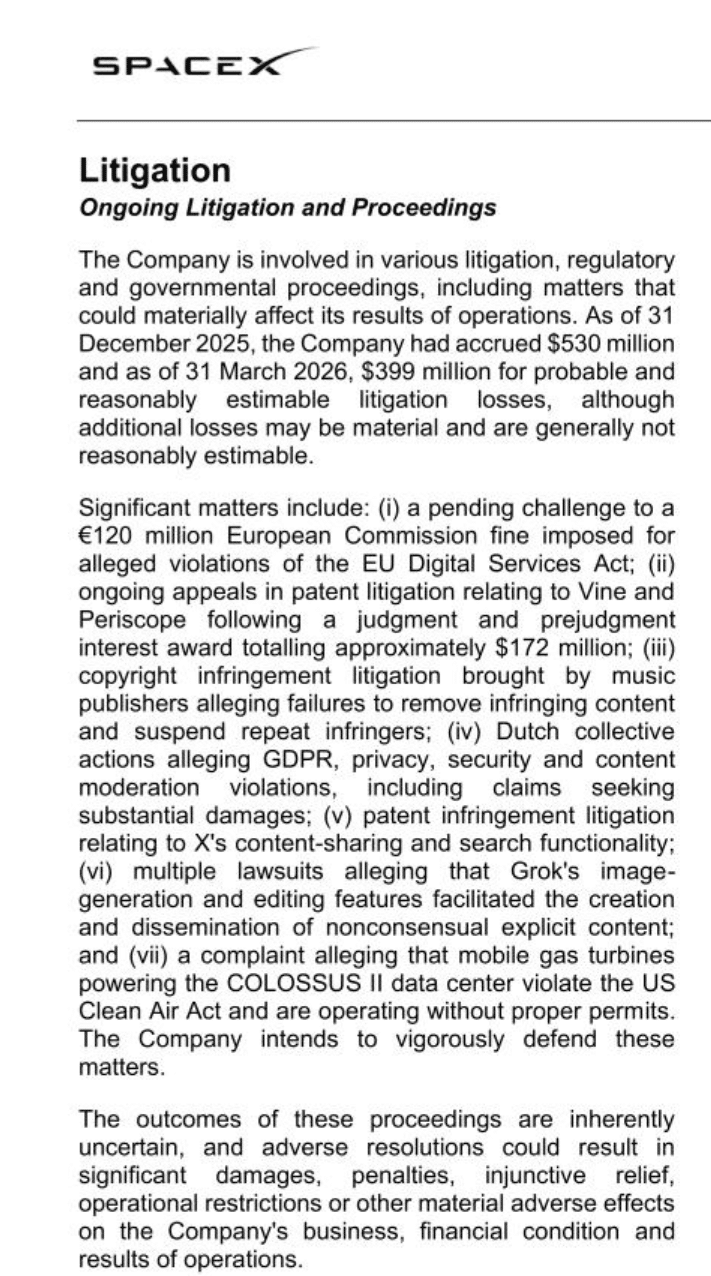
In a pre-IPO prospectus filed with the SEC, SpaceX listed the music publishers’ copyright case as one of seven significant litigation matters. Across all cases, SpaceX reported $399 million in accrued litigation losses as of March 2026. These are probable estimated losses that pose a risk to the company’s finances.
On August 4, SpaceX will announce its first-ever quarterly earnings as a publicly traded company. That’s also the date when several insiders can start selling stock. With that in mind, it doesn’t hurt to have a major liability resolved.
There is no evidence that SpaceX’s IPO directly caused the settlement. Both sides had other reasons to settle after Cox weakened the publishers’ case and the publishers’ dismissal motion threatened X’s antitrust claims. However, it may have played a role nonetheless.
Explosive Claims Fade Out
With both cases now dismissed, the explosive claims from both sides will never be tested in court.
That applies to the music companies’ mass piracy allegations against X, as well as X’s claim that the NMPA used its takedown campaign to inflict “maximum pain” on the social media company. Both claims remain unproven.
Whether the settlements include any financial arrangements remains unknown too. There is no mention of compensation from either side and no licensing deals have been announced either.
When the NMPA settled a similar dispute with Roblox in 2021, it publicly announced an industry-wide licensing deal. In that light, the silence on the X settlement, after more than a week later, is notable.
For now, the three-year legal war between X and the music industry is over. Whether more details will show up in future SpaceX SEC filings or industry disclosures has yet to be seen.
—
Copies of the joint stipulations of dismissal are available here (copyright claim – pdf) and here (antitrust suit – pdf).
From: TF, for the latest news on copyright battles, piracy and more.
Powered by WPeMatico

