

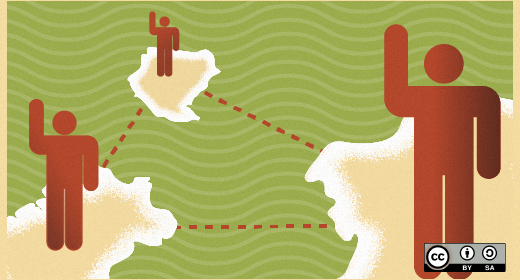

Know your organization’s rule makers and rule breakers
In the first part of my review of Michele J. Gelfand’s book, Rule Makers, Rule Breakers, I explained the author’s argument about the ways social norms impact organizational cultures. In this part, I’ll explore more deeply the ways understanding social norms can help leaders build open organizations. read more Powered by...
How open source software shapes AI policy, open source comes to medical datasets, and more
Open source made it into a lot of news headlines last month. Read on to learn about some of the major advances. read more Powered by...

Use this open source tool for automated unit testing
Modernizing and transforming legacy applications is a challenging activity that involves several tasks. One of the key tasks is validating that the modernized application preserves the functionality of the legacy application. Unfortunately, this can be tedious and hard to perform. Legacy applications often do not have automated test cases, or, if available, test coverage might be inadequate, both in general and specifically for...

10 steps to more open, focused, and energizing meetings
The negative impact of poorly run meetings is huge. So leaders face a challenge: how do we turn poorly run meetings—which have a negative impact on team creativity, success, and even cause stress and anxiety—to meetings with positive outcomes? But to make the situation even tougher, we now find most meetings are being held remotely, online, where attendees’ cameras are off and you’re likely staring at a green dot at the...
How to include options in your Bash shell scripts
Terminal commands usually have options or switches, which you can use to modify how the command does what it does. Options are included in the POSIX specification for command-line interfaces. read more Powered by...
Solve the repository impedance mismatch in CI/CD
An impedance mismatch in software architecture happens when there’s a set of conceptual and technical difficulties between two components. It’s actually a term borrowed from electrical engineering, where the impedance of electrical input and output must match for the circuit to work. read more Powered by...

